
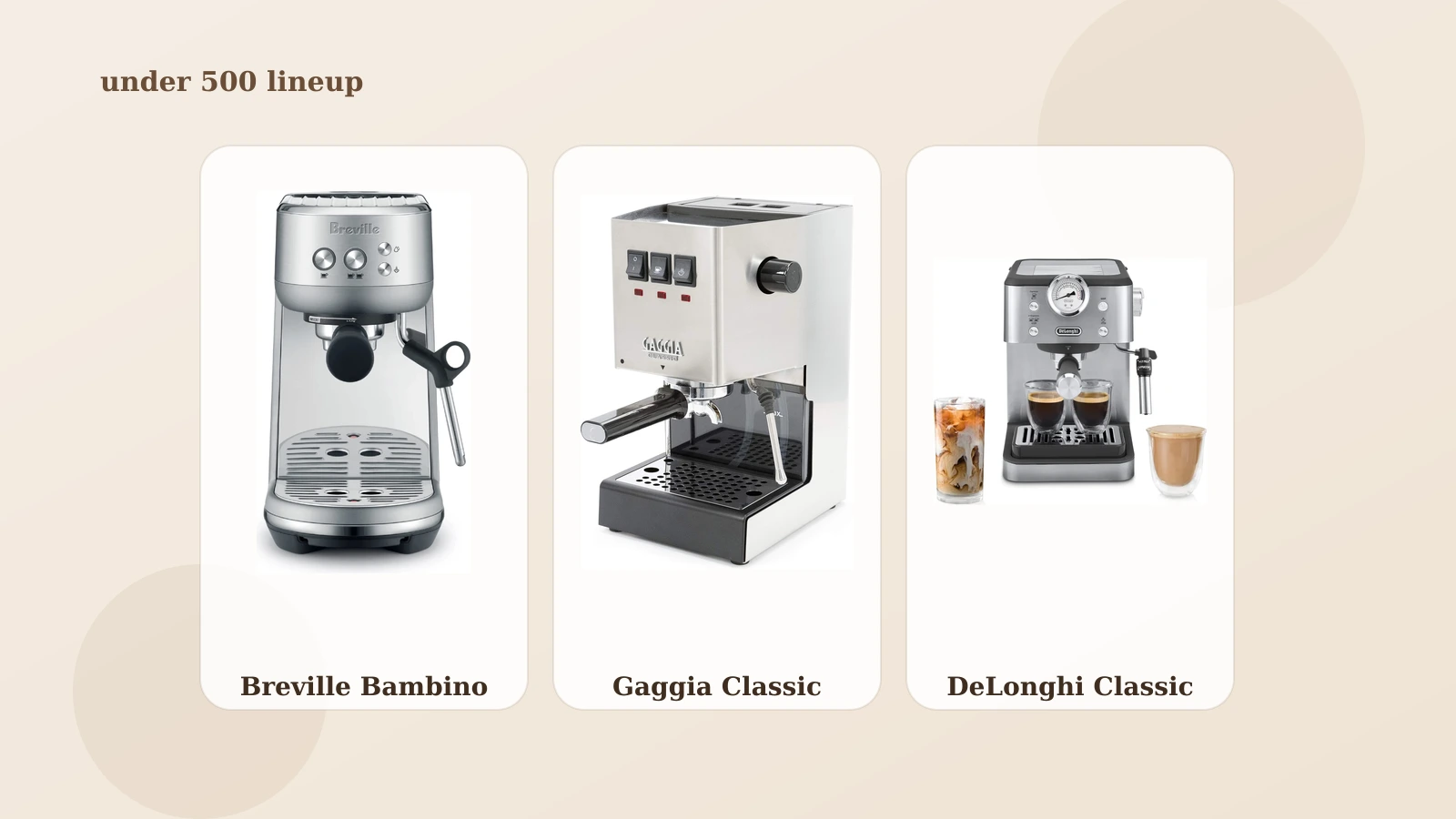
Decision Snapshot
Start With the Short Answer
These are the best espresso machines under $500 if you care about stronger shots, workable steam power, and a machine that still makes sense once the beginner stage wears off.
The $500 price point is where home espresso gets serious. Below this range, machines compromise on boiler size,
temperature stability, and build quality to hit a budget number. Above it, you enter prosumer territory with
features many home baristas never fully use. At $500, you get machines with real brass boilers, commercial group
head dimensions, and enough power to steam milk properly — the essentials without the excess.
This guide covers the best espresso machines under $500 as they stand in 2026, based on extraction quality, steam
performance, build longevity, and mod potential.
What to Look For at This Price Point
- Boiler material: Stainless steel or brass. Aluminum boilers corrode faster and transfer heat
inconsistently. Every machine on this list uses stainless or brass. - Portafilter size: 58mm portafilters give you access to the entire professional accessory
ecosystem (precision baskets, naked portafilters, tampers). 54mm (Breville) has a growing but smaller ecosystem.
51mm (DeLonghi) has the least options. - 3-way solenoid valve: When the pump stops, a solenoid valve releases the pressure from the
puck, making cleanup easy and preventing stale water from sitting in the group head. Machines without one leave
a wet, compressed puck that’s messy to knock out. - Steam wand quality: Important if you make milk drinks. A real commercial-style steam wand (no
Panarello auto-frother sleeve) gives you the control to create genuine microfoam for latte art.
Our Top Picks
1. Breville Bambino Plus (~$400)
The Bambino Plus is the most popular entry machine in the specialty coffee community for good reason. It uses
Breville’s ThermoJet heating system, which heats from cold to brew temperature in 3 seconds — no waiting, no
temperature surfing, just press and go. The automatic steam wand texturizes milk to a preset temperature, producing
acceptable microfoam without any learning curve.
The downside: 54mm portafilter (not the industry-standard 58mm), and the automatic steam wand limits advanced
baristas who want manual control. But for someone wanting great espresso with zero learning curve on the milk side,
the Bambino Plus is nearly unbeatable.
2. Gaggia Classic Evo Pro (~$450)
The Gaggia Classic has been continuously manufactured since 1991. The latest “Evo Pro” revision brings a 58mm
commercial portafilter, a commercial-style steam wand (replacing the old Panarello), and a 3-way solenoid valve.
This machine is legendary for its modability: adding a PID controller ($80–120) for precise temperature control
transforms it into a machine that rivals units costing $1,000+.
Out of the box, the Gaggia Classic Evo Pro runs at a stable ~93°C brew temperature and produces competent shots with
medium-dark espresso blends. Its 200ml stainless steel boiler generates enough steam for home use, though it’s
slower than the Bambino Plus. The real selling point: the 58mm portafilter gives you access to every professional
basket, tamper, and naked portafilter on the market.
3. DeLonghi Stilosa (~$120) — Budget Pick
If $400 is still too high and you want to try espresso before committing, the Stilosa is the least-bad option under
$200. It uses a 15-bar pump (regulated to ~9 bar in the portafilter), a pressurized basket that works with
pre-ground coffee, and a basic steam wand. It will not produce café-quality espresso — but it will produce
drinkable, strong, crema-topped shots that are significantly better than any pod machine.
Understand its limitations: 51mm portafilter with limited accessory options, pressurized basket that masks grind
issues, and no solenoid valve. This is a starter machine, not an end-game.
The Hidden Cost: The Grinder
Every machine on this list requires a capable burr grinder to perform. Do not buy a $450 espresso machine and pair it
with a $25 blade grinder — you will waste both investments. Budget at minimum $100–200 for a grinder alongside your
machine. A hand grinder like the 1Zpresso J-Max ($170) or Kingrinder K6 ($100) will dramatically outperform any
similarly-priced electric grinder for espresso.
Features That Don’t Matter at This Price
- “15-bar” or “20-bar” pump pressure: All these machines use similar vibratory pumps. The bar
rating is the pump’s maximum, not the actual brew pressure (which is regulated down to ~9 bars). Higher bar
ratings are marketing, not performance indicators. - Built-in grinders (at this budget): Integrated grinders under $500 are consistently
outperformed by even basic standalone burr grinders. Buy them separately. - Pre-programmed cup sizes: Programming that auto-stops the pump after a set time is unreliable
because shot timing changes with grind adjustments. Always stop your shots manually by weight using a scale.
Which One Should You Buy?
Bambino Plus if you want zero-effort milk drinks, fast heat-up, and a polished out-of-box
experience. Gaggia Classic Evo Pro if you want the most modable, upgradeable platform with a
commercial 58mm portafilter that you’ll never outgrow. DeLonghi Stilosa if you’re testing the
waters and want to spend under $150 before committing to a real setup.
For current live picks and prices, browse the Espresso Insider product hub.
These are the active catalog products that still clear our usefulness gate for this topic right now.

Chefman CraftBrew Digital Espresso Maker
The Chefman CraftBrew is designed as an accessible, high-yield espresso machine for the domestic kitchen. Equipped with a 15-bar vibratory pump and a 1.5-liter removable reservoir, the unit guarantees sufficient…
See Current Offer
OutIn Mino Portable Electric Espresso Machine, Mini Camping Coffee Maker for Travel, Pocket Sized Coffee Machine Self-Heating, Ground Coffee & NS Capsule Adapter For Adventure
OutIn Mino Portable Electric Espresso Machine, Mini Camping Coffee Maker for Travel, Pocket Sized Coffee Machine Self-Heating, Ground Coffee & NS Capsule Adapter For Adventure is a pod / capsule espresso machine built…
See Current Offer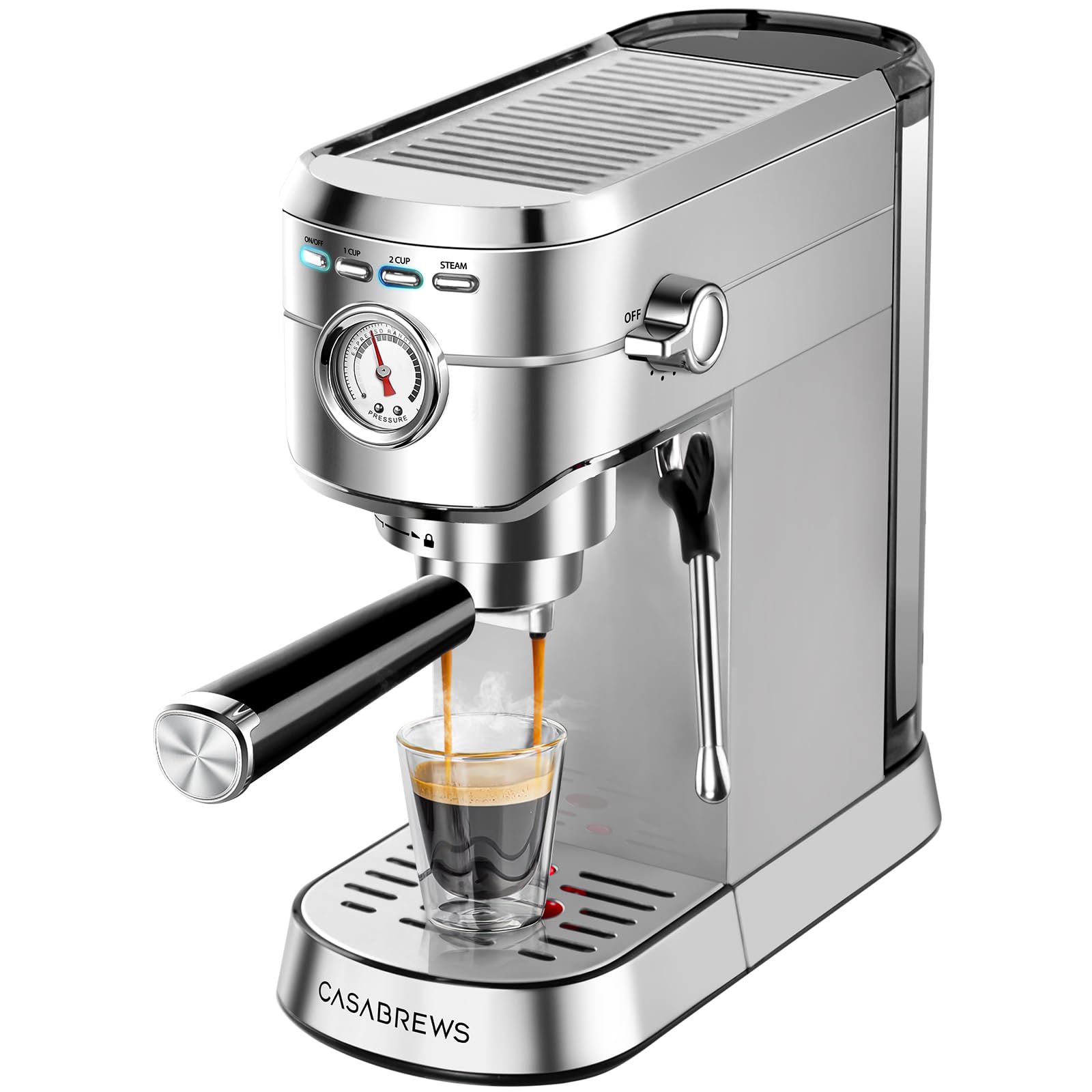
CASABREWS CM5418 Espresso Machine
CASABREWS CM5418 Espresso Machine is a semi-automatic espresso machine built around Make Your Favorite Espresso Coffee At Home: The CASABREWS coffee machine with milk frother allows you to prepare all your favorite…
See Current OfferFrequently Asked Questions
Before You Buy
Narrow the field to 2 to 4 options, compare the practical tradeoffs side by side, then click through to a retailer only after the choice is clear.