
Decision Snapshot
Start With the Short Answer
Pull up a YouTube video of a barista pulling espresso shots and watch how quickly they adjust a setting, pull a shot, taste, adjust again.
Pull up a YouTube video of a barista pulling espresso shots and watch how quickly they adjust a setting, pull a shot,
taste, adjust again. That process — methodical, iterative, sensory — is what dialing in means. And once you
understand the underlying logic, it works on any machine, from a $300 entry-level Breville to a $3,000
prosumer La Marzocco.
Dialing in isn’t guesswork. It’s understanding exactly one thing: extraction yield — how much of the
ground coffee ends up dissolved in your cup — and manipulating grind size to control it.
Key Takeaways

Before adjusting anything, freeze two variables and only change one at a time. The three variables are:
- Dose — the weight of dry ground coffee you put in the basket (in grams)
- Yield — the weight of liquid espresso in the cup (in grams)
- Time — how long the extraction takes (in seconds)
Your goal is a ratio. A classic Italian-style shot uses a 1:2 ratio — 18g in, 36g out in 25–30 seconds. A ristretto
is tighter (1:1.5). A lungo is more stretched (1:3). Pick a ratio, lock in your dose and yield, and only change
grind size to hit your time target.
What Grind Size Actually Controls
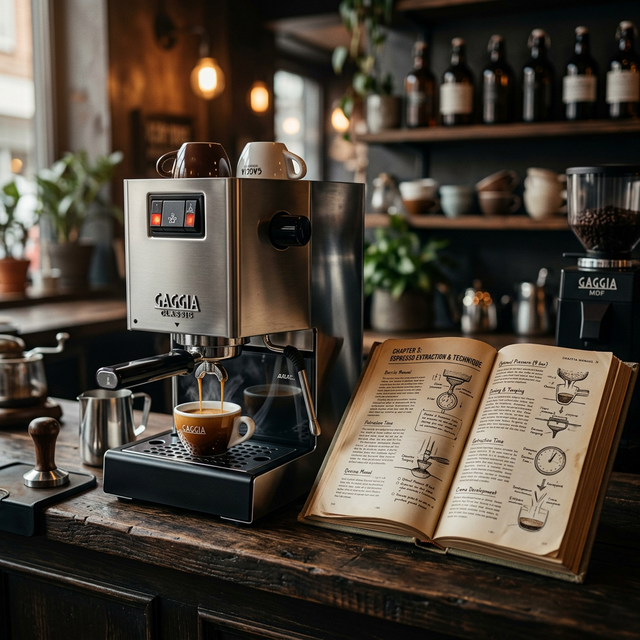
Your grind size controls the resistance the water encounters as it flows through the coffee puck at
9 bars of pressure. The finer the grind, the more tightly packed the bed, the longer the extraction takes. The
coarser the grind, the faster water flows through.
- Too fine: Shot runs slow (40+ seconds) → over-extracted → tastes bitter, dry, ashy
- Too coarse: Shot runs fast (under 20 seconds) → under-extracted → tastes sour, sharp, thin
- Just right: Shot runs 25–30 seconds → balanced → tastes sweet, syrupy, complex
This relationship is absolute. Sour espresso always means coarser grind or faster extraction. Bitter espresso always
means finer grind or slower extraction. Memorize this. It applies universally.

Meilen Mini Espresso Coffee Scale with Timer
The Meilen Mini Espresso Coffee Scale is designed for precision coffee brewing. Its ultra-thin profile fits under most espresso machines, while high-accuracy sensors measure from 0.3g to 2kg with 0.1g accuracy.…
See Current OfferStep-by-Step: Dialing In From Scratch
Step 1: Set a Starting Dose
Use the recommended dose for your basket size. A standard 58mm double basket is designed for 18–20g. A pressurized
(beginner) basket performs best at 14–16g. Check the marking on your basket or your machine’s manual. Weigh every
dose with a precision scale — eyeballing is not acceptable here.
Step 2: Set a Target Ratio
Start with 1:2. If your dose is 18g, your target yield is 36g in the cup. Put a scale under your cup, tare it to
zero, and start your shot. Stop the pump the moment your scale reads 36g.
Step 3: Time the Shot
Start your stopwatch when the first drops appear (not when the pump starts — there’s pre-infusion lag). If the shot
finishes in under 20 seconds, grind finer. If it takes over 35 seconds, grind coarser. Make one grind adjustment at
a time — small adjustments on quality grinders (like Eureka or DF54) make a significant difference.
Step 4: Taste and Then Adjust Ratio
If your shot hits 25–30 seconds but still tastes slightly sour, stretch the ratio longer (try 1:2.2 or 1:2.5). If
it’s in time but still slightly bitter, shorten the ratio (try 1:1.8). The grind size controls time; the ratio
controls the final flavor balance. Both matter.

Normcore WDT Distribution Tool V3
The Normcore WDT (Weiss Distribution Technique) tool V3 improves espresso extraction consistency. Featuring nine 304 stainless steel needles, it effectively breaks up clumps in coffee grounds before tamping, leading to…
See Current OfferWhy Different Coffees Require Different Settings
Every time you switch coffee, you’ll need to re-dial. This is not a flaw — it’s the nature of the product. Variables
that change with a new bag:
- Roast level: Dark roasts are more porous and extract faster — you’ll need a finer grind to
compensate. Light roasts are denser and need coarser grinds and higher temperatures. - Freshness: Coffee CO₂ outgasses over 1–4 weeks post-roast. Very fresh coffee (under 7 days
off-roast) has so much gas that it resists water flow — you may need to grind coarser. - Processing method: Natural-processed coffees extract differently from washed coffees. Expect to
adjust slightly even between coffees of similar roast level.
Channeling: The Hidden Problem
Even with a perfect grind, you can get bad shots from channeling — when water finds a weak spot in the puck and
gushes through it rather than flowing evenly. Signs of channeling: the shot ran fast but one side looks much darker
than the other, or you see streaks in your bottomless portafilter.
Fix channeling by: distributing grounds evenly with a WDT tool (a needle-based stirrer that breaks up clumps) before
tamping, and ensuring your tamp is perfectly horizontal. A level tamp creates an even-density disk that resists
channeling.
Temperature and Pressure: Advanced Knobs
Once your grind, dose, yield, and tamp are dialed, temperature and pressure tweaks offer 5–10% refinements. Higher
temperatures extract more efficiently — great for dense light roasts. Lower temperatures slow extraction and
preserve delicate floral notes. Most home machines allow temperature adjustment, either directly (PID controllers)
or via the “temperature surfing” technique (flushing before brewing to stabilize the group head).
How this changes by setup and roast
How to Dial In Espresso behaves differently depending on the coffee, basket, and drink goal in front of you.
A medium-dark milk-drink recipe rarely wants the same correction as a light roast you are drinking straight. The principle may stay the same, but the visible symptom and the best next move often change.
This is where a lot of search results flatten useful nuance into one universal rule. Espresso almost never behaves that cleanly in real kitchens.
That is why we keep steering readers toward our best espresso machines under $500 and our beginner machine guide for connected context rather than one isolated trick.
Real cup examples that reveal the problem faster
How to Dial In Espresso gets easier once you connect it to taste and texture instead of abstract theory.
If the cup is thin, sharp, and disappears in milk, that points to a very different next test than a heavy shot that tastes dry and flat.
Espresso is full of mixed signals, which is why visual perfection can mislead you. I learned that the hard way after chasing puck appearance instead of listening to the cup.
The practical move is to keep one baseline recipe and compare the result honestly before changing another variable.
What top results often miss
How to Dial In Espresso is usually under-explained by pages that define the concept but stop short of showing what to do next.
Readers do not just need vocabulary. They need a clean sequence for testing, a way to rule out false diagnoses, and a sense of which problems are not actually worth solving with more gear.
That is why we care about routine and use-case framing here. The theory only matters if it helps the next shot taste better.
If you want a direct next step, work through our Barista Express vs Barista Pro guide with a notebook and one controlled change.
What to test next
How to Dial In Espresso becomes much more useful once you run one disciplined experiment instead of five random tweaks.
Change one variable, pull two confirming shots, and write down what changed in sweetness, bitterness, body, and finish. That notebook habit feels nerdy until you realize how much coffee it saves.
The strongest home barista move is not memorizing more advice. It is learning how to isolate a change cleanly enough that the cup can actually teach you something.
That is the difference between reading espresso content and getting better at espresso.
For a wider technical reference, Specialty Coffee Association research is still worth bookmarking. For wider equipment and extraction context beyond this article, the Specialty Coffee Association research archive is a credible technical reference.
Frequently Asked Questions
Before You Buy
Narrow the field to 2 to 4 options, compare the practical tradeoffs side by side, then click through to a retailer only after the choice is clear.