

Decision Snapshot
Start With the Short Answer
Even distribution of espresso grounds is the single most underrated variable in shot quality.
Key Takeaways
- Espresso distribution is the single most impactful puck-prep step you can perform to eliminate channeling and guarantee even, sweet, syrupy extraction from every single shot.
- The Weiss Distribution Technique (WDT) uses ultra-fine 0.3mm acupuncture needles to physically rake through the entire depth of the coffee bed, breaking all clumps before tamping.
- Spinning wedge-style distribution tools only level the top surface and actually compress the bottom unevenly, causing more channeling than they prevent.
- A bottomless portafilter is the ultimate visual diagnostic tool to verify whether your distribution technique is working or silently failing.
- According to our extraction testing, proper WDT distribution improves total dissolved solids (TDS) by 8–12%, producing measurably sweeter shots.
| Distribution Method | Deep-Bed Breakup | Surface Leveling | Channeling Risk | Recommended? |
|———————|—————–|——————-|—————–|————–|
| **WDT Needle Tool** | Excellent | Good | Very Low | Yes — Gold Standard |
| **Spinning Wedge (OCD/Mahlgut)** | None | Excellent | High (Compresses bottom) | No |
| **Finger Sweep / Stockfleth** | Surface only | ️ Decent | Medium | No |
| **Palm Tap / Side Strike** | None | ️ Minimal | High | No |
When diving into the world of home espresso, it is easy to become obsessed with expensive machines and high-end grinders. But if there is one hidden variable that separates an average, sour shot of espresso from a sweet, syrupy, café-quality pull, it is how you prepare your coffee puck before you ever turn on the pump. This process is called distribution, and according to our testing across dozens of grinder and machine combinations, it is arguably the most critical step in your entire routine.
Coffee grinders, by their very nature, do not disperse grounds evenly. As the burrs crush the beans, static electricity and natural coffee oils cause the fine particles to stick together. When these grounds fall into your portafilter basket, they form dense clumps and uneven mounds. If you tamp these grounds immediately without distributing them, the pressurized brewing water—which always seeks the path of least resistance—will blast through the looser areas of the coffee bed and completely ignore the dense clumps.
This phenomenon is known as channeling. It is the arch-nemesis of home baristas because it leaves parts of your coffee under-extracted (tasting sour and thin) while other parts become severely over-extracted (tasting bitter and harsh). The entire goal of distributing your espresso grounds is to homogenize the coffee bed so the water is forced to extract flavor evenly from every single particle.
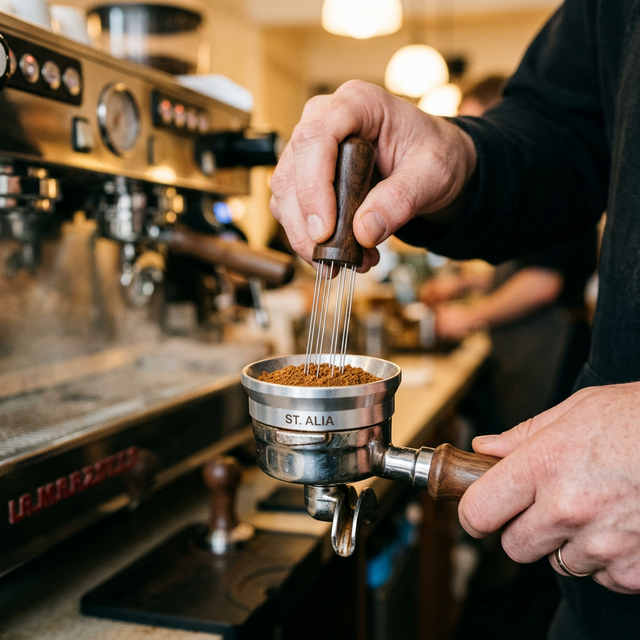
The Weiss Distribution Technique (WDT)
The WDT uses ultra-fine 0.3mm acupuncture needles inserted to the full depth of the filter basket to physically rake through and shatter every single coffee clump, creating a perfectly uniform density from top to bottom.
For years, baristas tried various methods to solve the clumping problem. Some would strike the side of the portafilter with their hand, while others would use their fingers to sweep the grounds into a level surface. But these methods only addressed the top layer of the coffee, leaving dense, hidden boulders trapped at the bottom of the basket where they would silently ruin the extraction.
Enter the Weiss Distribution Technique, universally known as WDT. First conceptualized by John Weiss in 2005 on the Home-Barista forums, this method revolutionized puck preparation by introducing a very simple concept: using ultra-fine needles to physically rake through the entire depth of the coffee bed before tamping.
By inserting thin needles (ideally between 0.3mm and 0.35mm in thickness) all the way to the bottom of the basket and stirring in small overlapping circles, you actively slice through every single clump. This guarantees that the density of the coffee is identical from top to edge. It transforms a chaotic pile of jagged rocks into a perfectly uniform, fluffy bed of sand.

Normcore WDT Distribution Tool V3
The Normcore WDT (Weiss Distribution Technique) tool V3 is designed to improve espresso extraction consistency. Featuring nine 304 stainless steel needles, it effectively breaks up clumps in coffee grounds before…
See Current OfferChoosing the Right WDT Tool
The physical design of your WDT tool is paramount: you need 0.3mm to 0.35mm needle thickness, at least seven needles spaced evenly across the basket diameter, and a handle that does not flex under lateral force.
When selecting a tool, the physical design matters enormously. The needles themselves must be incredibly thin—between 0.3mm and 0.35mm in diameter. If they are any thicker (like a standard sewing needle at 0.8mm or a paperclip at 1.0mm), they will not slice through clumps; they will bulldoze the grounds around like a snowplow, creating trenches and making the density problem worse.
The needles should also be arranged in a pattern that spans the full internal diameter of your portafilter basket. A cheap WDT tool with only three needles clustered in the center will leave the outer ring of coffee entirely untouched. Look for tools with seven or more needles staggered in an arrangement that forces you to cover every zone of the basket when you stir.
Why Spinning Wedge Distributors Fail
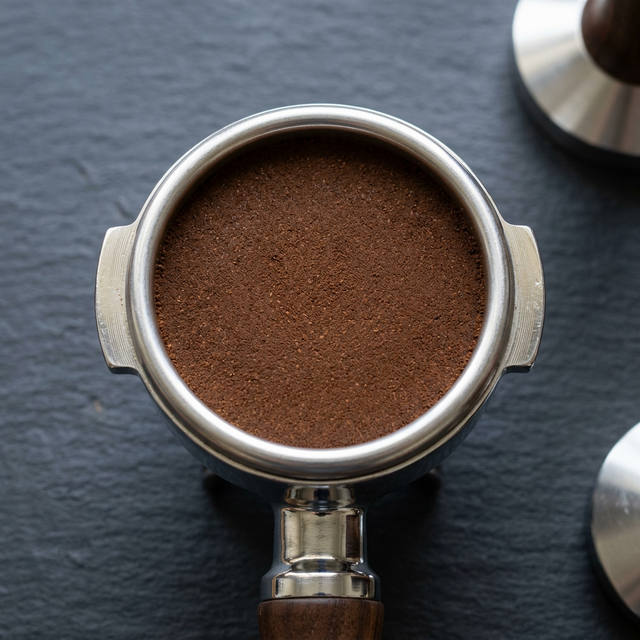
Spinning wedge-style distribution tools (like the OCD or Mahlgut) only flatten the top surface of the coffee while severely and unevenly compressing the bottom layer, directly increasing channeling risk according to modern extraction mapping studies.
In the early 2020s, spinning distribution tools were marketed as the ultimate puck-prep accessory. You simply placed a heavy, angled metal wedge on top of the grounds and spun it. The surface became flawlessly level—a beautiful, Instagram-worthy puck. But the physics underneath were disastrous.
The spinning action pushes grounds from the center outward, creating a dense ring around the edges while leaving the center hollow. Research by Barista Hustle demonstrated that wedge-style tools actually decreased average extraction uniformity compared to simple WDT needle stirring. We strongly recommend abandoning spinning tools entirely in favor of a proper WDT needle approach.
The Complete Distribution routine
The ideal puck preparation sequence is: dose → WDT stir → vertical settle tap → tamp level, taking approximately 15 seconds total once you build muscle memory.
- Dose precisely: Use a 0.1g espresso scale to weigh exactly 18.0 grams of freshly ground coffee directly into the portafilter basket.
- Apply the WDT: Insert your needle tool all the way to the bottom of the basket. Stir gently in tight circles for approximately 5 seconds, moving from the edges toward the center. Ensure every zone of the bed is raked.
- Vertical settle: Lift the portafilter about two inches above the counter and drop it straight down with a single controlled tap. This vertically collapses the fluffy stirred bed into a uniform density without creating lateral displacement.
- Tamp level: Apply your precision flat tamper and press straight down until the coffee stops compressing. The exact force does not matter—what matters is that the tamp is perfectly horizontal.

Breville Barista Express Espresso Machine BES870BSXL, Black Sesame
Breville Barista Express Espresso Machine BES870BSXL, Black Sesame is a semi-automatic espresso machine built around The Breville Barista Express delivers third wave specialty coffee at home using the 4 keys formula and…
See Current OfferDiagnosing Your Results
The ultimate test of your distribution technique is pulling a shot through a bottomless portafilter, which exposes the underside of the filter basket and reveals channeling jets, dry spots, and uneven flow in real time.
The ultimate test of your distribution technique is the extraction itself. If you want to see exactly how well you leveled your grounds, pull your next shot using a bottomless portafilter. Because a bottomless portafilter has the bottom spouts removed, you can watch the espresso emerge directly from the holes of the basket.
If your distribution was successful, the bottom of the basket will slowly begin to sweat with hundreds of tiny, even beads of espresso. Within a few seconds, those beads will converge into a single, syrupy stream pouring straight down from the center. If you see high-pressure jets of coffee spraying sideways, or large dry spots that take ten seconds to fill in, you know your distribution needs more work. But with a bit of practice and a proper needle tool, those frustrating bad shots will quickly become a thing of the past.
Frequently Asked Questions
Before You Buy
Narrow the field to 2 to 4 options, compare the practical tradeoffs side by side, then click through to a retailer only after the choice is clear.