
Decision Snapshot
Start With the Short Answer
Espresso brew ratios control everything — sweetness, intensity, body, and balance.
Your grinder churns out 18 grams of coffee. Your machine extracts it in 28 seconds. You get 36 grams of liquid in the
cup. But what does all of this actually mean? And why do espresso bars offer ristretto, normale, and lungo — and how
are they different?
This guide demystifies espresso ratios completely: what they mean, how to use them, and how to choose the right ratio
for your beans and taste preference.
Key Takeaways
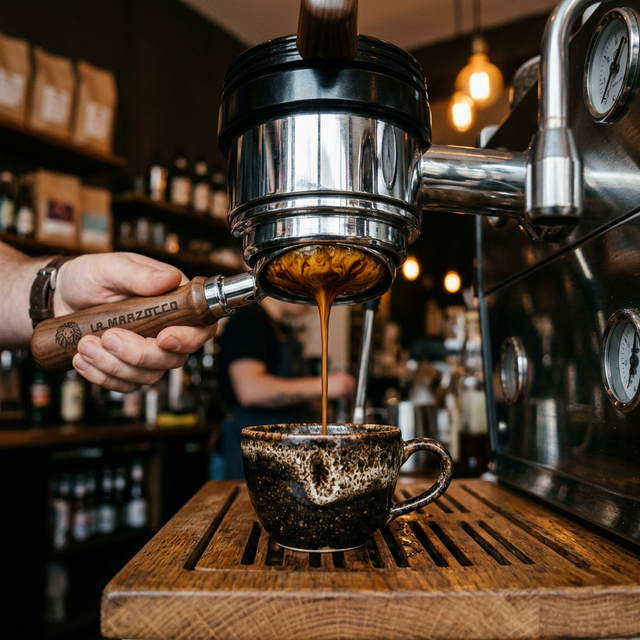
An espresso ratio is simply the relationship between the weight of dry coffee grounds you put into the portafilter
(the dose, measured in grams) and the weight of liquid espresso that comes out into your cup (the yield, measured in
grams).
It’s written as dose : yield — so 18g in, 36g out = a 1:2 ratio.
Why weight, not volume? Because coffee density changes. A gram of finely ground espresso and a gram of coarsely
ground pour-over produce different volumes. Weight is the only reliable, repeatable measurement. Always weigh your
dose and yield — a precision scale is not optional for anyone serious about espresso.

Meilen Mini Espresso Coffee Scale with Timer
The Meilen Mini Espresso Coffee Scale is designed for precision coffee brewing. Its ultra-thin profile fits under most espresso machines, while high-accuracy sensors measure from 0.3g to 2kg with 0.1g accuracy.…
See Current OfferThe Three Classic Espresso Ratios
Ristretto — 1:1 to 1:1.5
A ristretto (Italian: “restricted”) is a short, concentrated shot pulled by stopping extraction early. Using 18g in,
you’d stop at 18–27g out. Because extraction stops before the bitter, higher-solubility compounds dissolve, a
ristretto tastes intensely sweet, syrupy, and chocolatey with almost no bitterness. The texture is remarkably thick.
Ristrettos are the secret weapon in specialty coffee milk drinks — many top baristas use a 1:1.5 ristretto as the
espresso base in their flat whites because the concentrated sweetness cuts through milk more effectively than a
normale.
Normale — 1:2 to 1:2.5
The normale is the classic espresso. With 18g in, you target 36–45g out in 25–35 seconds. This is the most balanced
ratio — sweet, acidic, and bitter compounds are all present in proportion. You get full crema development, a
pronounced aroma, and enough volume to drink as a standalone shot or use as a foundation for any milk drink.
Most recipes and coffee bag brewing notes reference the 1:2 normale as their baseline. Start here every time you open
a new bag before experimenting further.
Lungo — 1:3 to 1:4
A lungo (“long” in Italian) extracts more liquid from the same dose. 18g in, 54–72g out. Because extraction continues
further, more bitter, astringent compounds dissolve into the drink. Lungos are larger in volume and lower in overall
sweetness — more similar in character to a concentrated drip coffee than a true espresso.
Lungos are often misunderstood. They are not just “more espresso” — they represent a fundamentally different
extraction window and are best suited to specific bean profiles (often light-roasted, high-acid naturals). Automatic
capsule machines like Nespresso use programmed lungo ratios to accommodate users who prefer a longer drink without
an Americano.
How Ratio Affects Flavor
| Ratio | Character | Best for |
|---|---|---|
| 1:1 – 1:1.5 (Ristretto) | Thick, sweet, syrupy, no bitterness | Milk drinks, dark roasts |
| 1:2 – 1:2.5 (Normale) | Balanced, full crema, complete flavor | Straight shots, most milk drinks |
| 1:3 – 1:4 (Lungo) | Larger volume, more bitter, herbal | Light roasts, longer drinks |
Ratio vs. Time: Two Different Things
A common confusion: grind size controls time, not ratio. Ratio is controlled by when you stop your pump. You
can have a 1:2 ratio that takes 20 seconds (under-extracted, too coarse) or 45 seconds (over-extracted, too fine).
The ratio and the time must both be in range simultaneously for a well-extracted shot.
This is why a scale and a timer working together are both essential. A scale alone tells you your yield. A timer
alone tells you your flow rate. Together, they let you diagnose whether a problem is a ratio issue or a grind issue.

TIMEMORE Coffee Scale Basic 2.0
The TIMEMORE Coffee Scale Basic 2.0 is a compact and accurate digital scale designed for coffee enthusiasts. It features high-precision sensors, a built-in timer, and a water flow rate function to help you perfect your…
See Current OfferChoosing Your Starting Ratio
When brewing a new coffee for the first time: always start at 1:2. It is the most forgiving, best-documented, and
most widely tested ratio in espresso. If the shot tastes balanced but thin, try 1:1.75. If it tastes harsh and
bitter, try 1:2.2. Small ratio adjustments make big flavor differences — move in 0.1–0.2 increments and taste after
every change.
How this changes by setup and roast
Espresso Ratios Explained behaves differently depending on the coffee, basket, and drink goal in front of you.
A medium-dark milk-drink recipe rarely wants the same correction as a light roast you are drinking straight. The principle may stay the same, but the visible symptom and the best next move often change.
This is where a lot of search results flatten useful nuance into one universal rule. Espresso almost never behaves that cleanly in real kitchens.
That is why we keep steering readers toward our perfect shot guide and our sour espresso troubleshooting guide for connected context rather than one isolated trick.
Real cup examples that reveal the problem faster
Espresso Ratios Explained gets easier once you connect it to taste and texture instead of abstract theory.
If the cup is thin, sharp, and disappears in milk, that points to a very different next test than a heavy shot that tastes dry and flat.
Espresso is full of mixed signals, which is why visual perfection can mislead you. I learned that the hard way after chasing puck appearance instead of listening to the cup.
The practical move is to keep one baseline recipe and compare the result honestly before changing another variable.
What top results often miss
Espresso Ratios Explained is usually under-explained by pages that define the concept but stop short of showing what to do next.
Readers do not just need vocabulary. They need a clean sequence for testing, a way to rule out false diagnoses, and a sense of which problems are not actually worth solving with more gear.
That is why we care about routine and use-case framing here. The theory only matters if it helps the next shot taste better.
If you want a direct next step, work through our temperature stability guide with a notebook and one controlled change.
What to test next
Espresso Ratios Explained becomes much more useful once you run one disciplined experiment instead of five random tweaks.
Change one variable, pull two confirming shots, and write down what changed in sweetness, bitterness, body, and finish. That notebook habit feels nerdy until you realize how much coffee it saves.
The strongest home barista move is not memorizing more advice. It is learning how to isolate a change cleanly enough that the cup can actually teach you something.
That is the difference between reading espresso content and getting better at espresso.
A practical home test plan
Espresso Ratios Explained: 1:1 Ristretto to 1:3 Lungo becomes more useful when the concept turns into a repeatable home test instead of extra theory.
Keep the setup steady and run one controlled change at a time. That might mean adjusting yield, grind size, water choice, milk texture, or one maintenance step, but it should not mean changing all of them together.
Then write down what happened in the cup. Sweetness, bitterness, body, clarity, and finish are the signals that matter. When you capture those consistently, the lesson becomes practical instead of abstract.
This is also the fastest way to stop wasting coffee chasing contradictory advice that was never tested in your setup.
For a wider technical reference, Barista Hustle is still worth bookmarking. For a second expert reference on espresso technique and calibration language, Barista Hustle remains one of the cleaner resources on the web.
Frequently Asked Questions
Before You Buy
Narrow the field to 2 to 4 options, compare the practical tradeoffs side by side, then click through to a retailer only after the choice is clear.